

Part I: Let’s Talk About Shale Gas!
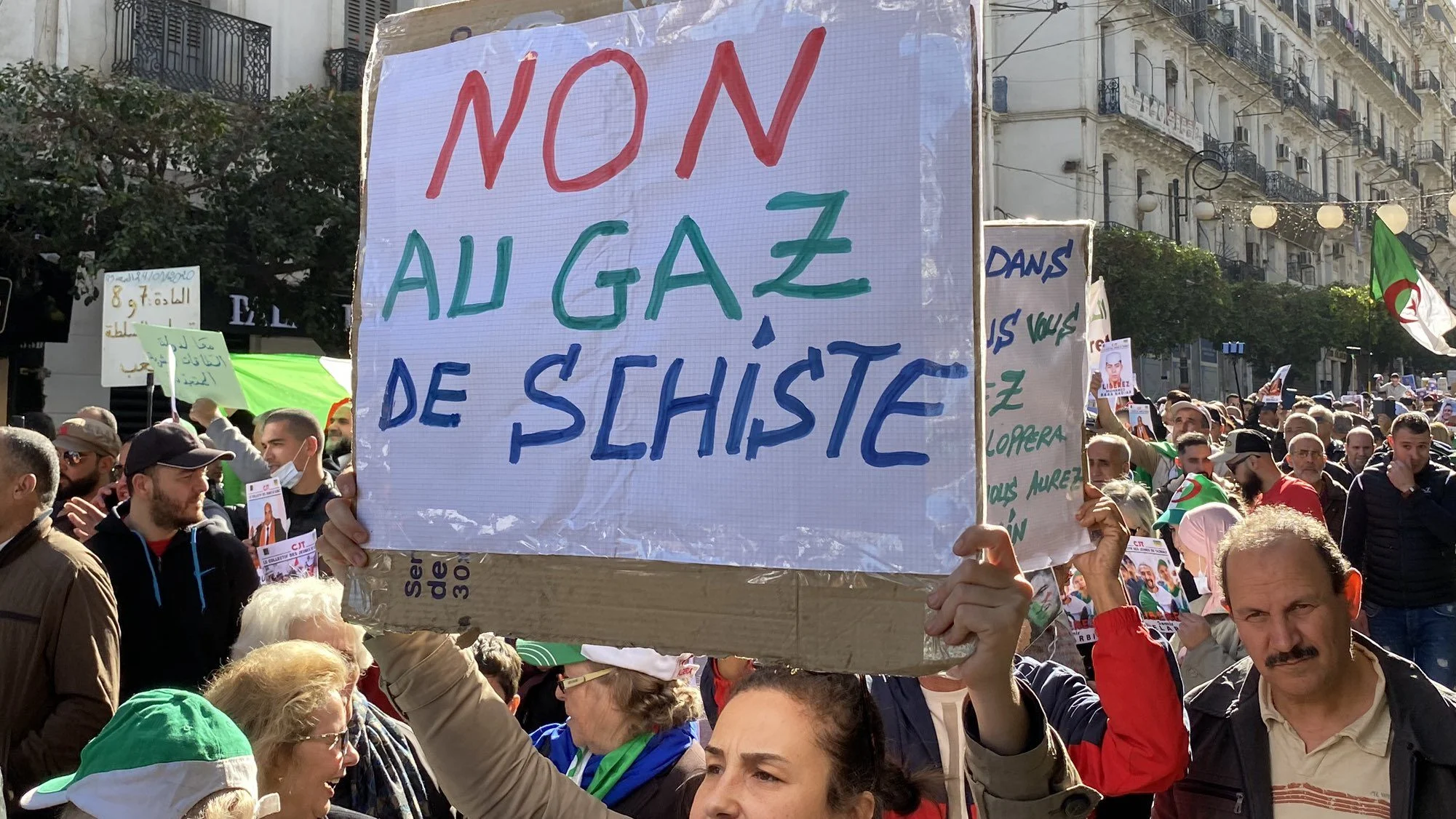
An article published in Maghreb Émergent on the 15th of this month, picked up by other media outlets, reveals that Algeria — or should I say the regime — is about to conclude a major agreement with two American giants: ExxonMobil and Chevron. More recently still, other American companies, and not minor ones (Schlumberger, Halliburton, friends of the famous Ould Kaddour, as well as Petrooxy…), have set their sights on the hydrocarbon wealth of the Algerian subsoil, and in particular on the highly controversial shale gas.
This raises a host of questions, as our friend Saad Kermiche rightly points out from Canada. He reminds us that shale gas extraction is far from being as profitable in Algeria as it is in the United States, for objective reasons — at least in theory.
Let’s break them down:
- For a well to be profitable, it should not cost more than 6 to 7 million dollars in the United States, whereas in Algeria, costs would quickly climb to 20 million.
- Thousands of wells would need to be drilled simultaneously to achieve meaningful exploitation, given the phenomenal quantities of water required for hydraulic fracturing (the technology most used by the American majors). Yet if environmental concerns were genuinely taken into account, costs would skyrocket.
- Between the exploration phase and the exploitation phase, up to ten years can pass — especially in a context of rapid development of renewable energy.
- The security situation in the South is volatile and could dampen the enthusiasm of these companies.
He concludes that the regime has a poor reading of present and future events, and that its bet on mortgaging our resources in exchange for international support to ensure its political survival is illusory.
Allow me to respond to him briefly and humbly.
The profitability of a well in Algeria is in no way comparable to that of an American well, for several objective reasons:
- The cost of water is far higher in the United States than in Algeria, where the exploitation of the Albian aquifer has no doubt already been secured at unbeatable prices. Yet water accounts for a substantial share of costs.
- As for the thousands of wells needed, the Saharan region is vast and free of urban constraints, unlike the United States. Drilling again and again will not be an obstacle.
- Environmental concerns? Allow me to doubt it. It is even likely that certain chemical products banned in the United States will be used here without hesitation.
- Shale oil will also be exploited at these same sites, in addition to the gas. And all of it will be destined for the nearby European market, reducing transport costs. The quality of Saharan gas, it seems, would also require less refining, making it even more attractive.
- As for the famous decade of waiting before exploitation, it is highly uncertain. Some sources claim that exploration studies have never stopped since 2014 or 2015… Do the math.
- Finally, on security: even at the height of the “black decade,” foreign companies, particularly American ones, managed to protect their facilities. Apart from Tiguentourine, no major incident has been reported.
As for the survival of the regime, let us recall that for it, even 24 more hours are worth taking. It operates on a logic of total retrenchment.
Part II: Exploitation of the Albian Aquifer
This aquifer covers 70% of our territory. Water reserves are estimated at between 30,000 and 50,000 billion m³. We can therefore reasonably conclude that Algeria’s reserves would represent 21,000 to 35,000 billion m³. A colossal reservoir.
According to NASA and the Sahara and Sahel Observatory, this aquifer is renewable at a rate of 1.4 billion m³/year. Yet current pumping already stands at 2.7 billion. In other words, we are consuming almost twice its rate of renewal.
And that’s not all: the pollution generated by operators, conventional or otherwise, is far more problematic. The example of Haoud Berkaoui speaks for itself: Total and Sonatrach point the finger at each other, while around El Oued, a gaping pit keeps widening, causing unprecedented pollution and salt-water intrusion. Who today can estimate the volumes contaminated? Who cares?
Algeria’s annual water consumption is estimated at nearly 11 billion m³ (of which 2.13 billion for drinking water, agriculture, and industry). Set against the Albian aquifer, this would represent between 1,840 and 3,500 years of consumption… except that our real needs are already three times higher, and this aquifer, although theoretically clean and untouched, is threatened by the irresponsibility of the authorities.
The Giant Farms
Before turning to shale gas, let’s mention the giant agricultural farms being set up in the South, modeled on the American system.
Dr. Rabah Lahmar, an Algerian agronomist, describes them as “how to desertify a desert.” He explains that while initial yields are spectacular, they decline rapidly. The reason: Albian waters are salty, and in low-retention soil, salts accumulate and sterilize the land. This would require precise mastery of irrigation and drainage systems… but who will bother? The example of Saudi Arabia should serve as a warning.
Shale Gas and the Albian Aquifer
Shale gas extraction risks consuming phenomenal quantities of water: 15,000 m³ for a single fracturing operation. Yet a well requires several fracturing operations. At a rate of 1,500 wells needed to reach profitability, the volume of water pumped from the Albian aquifer will be colossal.
Worse still: contamination. The chemical additives used in fracturing can render an entire aquifer unfit for consumption over several kilometers around. Decontamination, if even possible, is extremely costly and often irreversible. In the United States, entire populations have had to be relocated due to water contamination, not to mention seismic tremors and health impacts.
Let us add that a well’s lifespan does not exceed five years: operators then move on to the next one, turning the area into a veritable Swiss cheese.
A Dubious Purpose
Behind these choices, the question is not only profitability. Will they help diversify our economy, or simply prolong the rentier system? Knowing the regime’s philosophy, one may well doubt it.
All the more so since the rapid development of renewable energy — particularly solar power, where Algeria has immense potential — makes this fossil-fuel gamble even more absurd. But for a regime obsessed with its own survival, “the sky is the limit”: everything can be sold off.
We face two major threats to our national future:
- the squandering of our natural resources (the Albian aquifer, mines, Saharan lands, hydrocarbons);
- the destruction of our environment, with serious health consequences for our populations.
We no longer have a choice. It is not enough to denounce these criminal choices: we must oppose them legally, socially, and politically. May every citizen concerned about the future of coming generations raise their voice to say: “No pasarán!”