

I Accuse
I accuse…
✍️ Si Ahmed Sidi Mennad, President of the Tafelwit Association
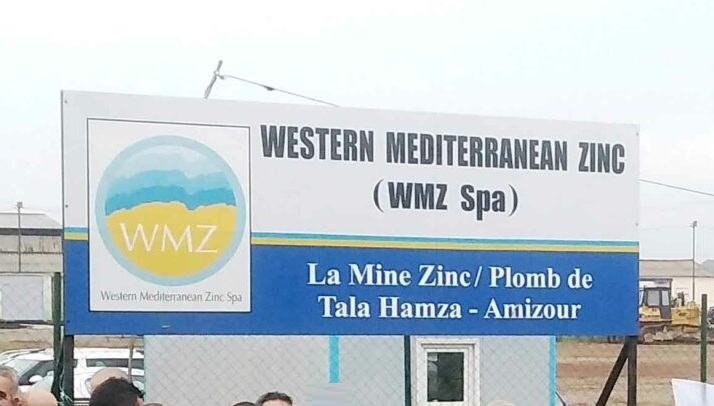
I do not want to be pessimistic at all; I will simply present the figures published by the Australian company “Terramin” on its own website, updated in March 2026 and available to any citizen wishing to learn the details and background of the exploitation of this mine — a mine presented as strategic for our economy, particularly by the author of that laudatory article.
Judge for yourselves.
The mining site known as “Tala Hamza” holds reserves exploitable for close to twenty years, estimated at 53 million tonnes of ore, at a grade of 5.3% zinc and 1.3% lead — equivalent, at best, to 2,810,000 tonnes of zinc and 689,000 tonnes of lead, in addition, of course, to 48 million tonnes of waste or barren material.
Terramin plans to produce 130,000 tonnes per year of zinc concentrate and 26,000 tonnes per year of lead concentrate for export, based on extracting 1.4 million tonnes of ore annually — which also means producing 1.4 million tonnes of waste or barren material every year.
Total investment in BZL — that is, Terramin (49%) and its Algerian partners Sonarem and Enafor (51%) — is around 341 million US dollars, financed as loans from Algerian banks.
Expected annual revenue is estimated at around 392 million US dollars, from which operating costs are deducted: 161 million dollars for zinc ($1,170 per tonne) and $135 per tonne for lead, resulting in a theoretical profit of 231 million dollars for BZL — equivalent to 118 million dollars per year for the two Algerian institutions and 113 million dollars for Terramin.
These figures do not include the initial investment (341 million dollars to be repaid over an undisclosed period), nor the costs of rehabilitating the site after operations end (Terramin specifies neither the approximate cost nor who will bear it), nor capital depreciation.
Nevertheless, as we will see below, the operation remains profitable for Terramin despite all these costs.
In fact, this company, which is in a critical financial situation, benefits from an Algerian bank loan (thanks to its partnership with Sonarem and Enafor) without making any direct financial contribution to the investment. It claims to provide expertise and technical know-how in mine management (whereas its only experience to date is a zinc mine in South Australia that has since been closed), and it will also take over full management of the mine. So what, then, is the real contribution of the two Algerian companies?
Even more striking are the following privileges granted to Terramin:
«Terramin retains project management rights.
Existing, developed infrastructure, with low and favorable electricity and fuel costs.
Corporate tax exemption for 10 years.
Exemption from value-added tax and customs duties.
Long-term, low-interest loans from Algerian public banks.»
More importantly, the project is located in Algeria, on the Mediterranean coast, just 15 kilometers from the city of Béjaïa.
The city of Béjaïa has significant infrastructure, including an international airport and a deep-water port.
Among the advantages of this site are the availability of local labor, access to the electricity grid, abundant water, and its proximity to European zinc smelters (which simply means exporting zinc and lead concentrates).
Terramin also states that the Algerian government will provide the project’s basic infrastructure (at the state’s expense), including:
• A berth at the port of Béjaïa (under construction)
• A high-voltage power supply to the mining site (under design)
• Truck access ramps on the highway (under design)
• A bridge for mine transport traffic over the local road (under design)
This raises the question: even assuming everything goes exactly as planned and under the best conditions, do annual profits estimated at 230 million dollars for the Algerian side (not counting its contributions listed above) justify the destruction of the Soummam Valley, and the financing of a virtually unknown foreign company in Australia that is experiencing serious financial difficulties?
From an environmental standpoint, even Terramin provides no precise details on how it will manage the mountains of waste (barren material), merely referring to storage ponds, and does not clarify the type of water treatment plants involved (primary, chemical, etc.), let alone address the full range of harms such as dust, noise, highly polluting transport, destruction of plant and animal life, and impacts on residents’ health.
All of this carries an enormous cost that no one is talking about. Why? Who is behind this looming disaster? And who, besides Terramin, benefits from an operation that serves neither the country’s economy, nor the region’s economy, nor our natural heritage? We recall that the Soummam Valley is classified as a globally significant natural heritage site under the Ramsar Convention.
I accuse all the officials behind these plans.
I accuse all those who know and say otherwise.
I accuse all those who know and remain silent.
Shame on them. A day will come when all of them will be held accountable before justice, for crimes such as these are not subject to any statute of limitations.