


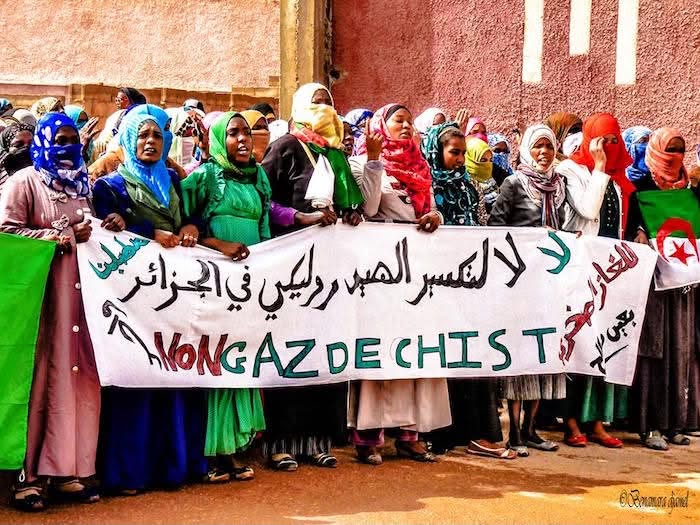
SHALE GAS: A DANGER TO WATER, THE ENVIRONMENT AND FUTURE GENERATIONS
By Abbes Hamadene.
Electricity consumption in Algeria is generated almost 99% by thermal power plants fuelled by natural gas, and it keeps growing year after year.
It is driven by galloping urbanisation, the ever-rising consumption of households and factories, and the air conditioning of homes, administrative buildings, hospitals…
THE PERMANENT GROWTH OF ELECTRICITY CONSUMPTION FORCES STRATEGIC CHOICES
This surging growth in electricity consumption considerably reduces the country’s capacity to export gas.
Indeed, every rise in domestic demand inexorably reduces the quantities available for export.
Despite ongoing investment and exploration, domestic demand will continue to absorb an ever-growing share of national production.
To preserve the strategic option of gas exports, it has become imperative for those in power to find other energy sources to accompany rising electricity demand.
This is all the more true given that gas exports are a strategic lever for those in power, who use them constantly to secure the support of certain European powers (Germany, Italy, Spain, France), particularly since the gas crisis linked to Russia’s war against Ukraine.
However, in order to maintain the level of natural gas exports and prolong its status as a major player in the international gas market, those in power face a choice: the salutary option based on developing renewable energy, or the disastrous option of shale gas.
There is still time to act and to accelerate the rollout of a strategy for a genuine energy transition, especially given that Algeria has one of the largest solar reserves in the world, not to mention its wind potential (energy obtained from the force of the wind) or green hydrogen (energy obtained by electrolysis of water).
Clearly, exploiting shale gas is a catastrophic choice and a major danger to the environment and to the population.
THE CATASTROPHIC TECHNIQUES USED TO EXTRACT SHALE GAS
Extracting shale gas is extremely complicated. It relies on the use of hydraulic fracturing (“fracking”), a technique that has changed very little since it first appeared in 1940.
This technique consists of breaking up shale rock buried underground by injecting, under high pressure, phenomenal quantities of water mixed with extremely toxic chemical substances.
The water injected into the wells is mixed with products whose chemical composition is a trade secret (some studies mention dozens of chemical substances!).
To reach the rock containing shale gas, the boreholes are very deep and widen pre-existing fissures still further. Sometimes these boreholes pass through layers containing radioactive minerals (uranium, radium).
Once released, radioactivity always ends up rising back to the surface, and no one knows how long it takes to dissipate. Indeed, depending on its composition, radioactivity can take hours, months, or billions of years to disappear.
It should be added that since the deposits are generally very small, operating companies are forced to drill a very large number of wells in order to extract quantities that are significant and financially profitable.
SHALE GAS PRODUCTION BANNED IN EUROPE
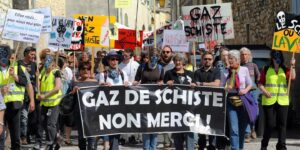
In the early 2000s, many European countries launched shale gas exploration (Poland, France…).
Faced with warnings from environmental and public-health organisations, as well as strong popular mobilisation, most European countries decided to halt this potentially very risky exploration.
Even the British Conservative government, though very favourable to shale gas, decided to halt exploration work on this gas from 2 November 2019.
It was forced to make this decision following the earthquake that struck near Blackpool, in Lancashire (north-west England), in August 2019. This earthquake was a direct consequence of shale gas exploration work.
The USA is almost the only country in the world to have taken the shale gas path, despite several reports from independent organisations that have been sounding the alarm for years over the extremely harmful consequences of shale gas extraction in the USA, particularly in certain states: Pennsylvania, Texas and Louisiana.
The cost in environmental, social and health terms is more than alarming: massive destruction of landscapes, water pollution, proliferation of invasive plants, dangerous emissions of methane and other greenhouse gases, repeated earthquakes, residents fleeing areas near the operations…
None of this is surprising when one knows that American political leaders traditionally place short-term financial profitability at the heart of their priorities: business is business.
SHALE GAS IN ALGERIA: A BOUTEFLIKA PROJECT SUSPENDED THANKS TO POPULAR MOBILISATION
The Algerian authorities’ temptation to turn to shale gas production has recurred regularly since 21 May 2014, when Bouteflika gave the green light to launch shale gas exploration and exploitation.
Law No. 19-13 on hydrocarbons, which came into force on 22 December 2019, renewed the inclusion of shale gas exploitation, already present in a previous law.
The new authorities embodied by Tebboune have thus shown their intention to continue the project initiated by Bouteflika.
It should be recalled that as early as March 2019, contracts with France’s Total and America’s Exxon Mobil were being finalised in the field of shale gas.
These projects were delayed thanks to the mobilisation of the population, and notably the valiant resistance of the residents of In Salah, before the Hirak came to jeopardise them for an indefinite period.
However, it is by no means excluded that the temptation of shale gas remains intact within certain circles of power.
Clearly, for them, exploiting shale gas can open new prospects for new and promising money-embezzlement operations.
According to several recent studies, Algeria would hold the world’s third-largest shale gas reserve, behind China and Argentina.
Such a situation continues to whet the appetite of the largest imperialist powers and their hydrocarbon multinationals (ExxonMobil, Chevron and Eni, Total…).
The equation always remains the same: the great predatory powers plunder the country’s wealth and, in return, provide support to those in power and help set up corruption networks to facilitate the embezzlement of the people’s money.
Algerian women and men know that shale gas extraction can pose serious risks to residents’ health and cause severe, irreversible harm to the environment, particularly to the Albian aquifer (70% of which lies within Algerian territory).
This aquifer is the largest freshwater reserve in the world; it is an inestimable treasure for future generations and can become a driving force for the country’s development.